December:
"Rowan Fall" and Poetry in the
Key of Minor
(click on image to enlarge)
|
"There's a charged whispering
ever higher and less soft /
the sea turns its ear;
and listens,
and hears
how after the night
before tomorrow
stormy weather is on its way."
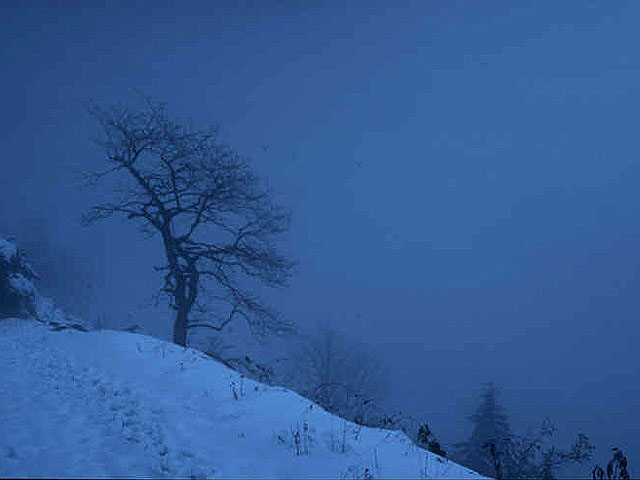
This week, an image from the
Alps, "Rowan
Fall". Also: ten
new translations of Lowland
poems.
|
Tien Gedichten; Ten
Poems
The guest poems for this week are new English
translations of a set of ten Dutch pieces.
The featured poets are, Edithe de Clercq
Zubli, Ellen Warmond, Anton Korteweg,
Louise van Santen, Gerrit Achterberg, Herman de Coninck,
Paul van Ostaijen,
K. Michel
and Han G.
Hoekstra:
"Poetry in the Key of
Minor"
In music, one of the mysteries of mysteries
is how the difference of but
half a tone, of tuning a major third
down a half step to a
minor
third, seems
to shift the quality of a sound from from bright to dark, from day to night.
Indeed, there is a quality of moving out, of ascending, which we hear in
the major third. In contrast, the minor, or smaller, third seems more pensive
and descending in nature.
What we are sensing, it seems to me, has something to do with
how sound
centers itself in space. In a way, one could
say that these different tonal qualities
of ascent and descent are much like the crown and roots of a tree. The comparison
does bring out something I'd like to give emphasis to here, which is the
comple-
mentarity of the two different movements we think of as major and minorand
more especially the balance between them.
Balancein
flowing movement. Of course we could say that this is not only
of great concern in music and poetry, but also, in a more metaphorical sense,
a concern of culture as a whole. Associated with this equipoise of major
and
minor tonalities in music is also of course a certain feeling or character.
In both
German and Dutch this relationship reveals itself in the words,
"Stimmung"
or
"stemming"
, which in both languages mean not just 'a system of intonation'
but also a certain quality of mood, for example, happy or sad.
Whereas these
descriptive terms suggest stereotypes which we these days might find superficial,
or lacking in subtlety, they do point to something significant. Again, I
think
it is because they direct our attention to the ever-present problem of balance.
Too much sugar and our tea is too sweet; too little, and for many, it's too
bitter.
The reason I have brought together the following ten Dutch poems is that
they,
individually but more especially as a sequence, create a kind of mood which
is
reminiscent of a minor key. In poetry, this relates also of course to sound:
A
darkness of vowels; a slowness of rhythm; an absence of bright, ringing rhymes
and their associated simple beat patterns or meters. But also, it relates
naturally
to theme or subject matter. We begin the sequence with a reference to perhaps
the largest and most primal earth-bound mood of allthe weather, and
from
there quickly move through different qualities of intimate space in poems
which
address belovèds lost, or no longer loved, or found again in a dream,
or about
whom we remain stuck in ambivalence.
But this is not the German minor, with both its profound magnificence
in, for
example, the works of J.S. Bach or the mature poems of Rilke, as well as
its
historical tendency to get carried away with the excesses of
Sturm und
Drang.
(Here I have in mind the, for me, overly gloomy masterpieces like
Schönberg's
Erwartung or Rilke's
Duino
Elegies.) Rather, the reader will
find here I hope
a distinctly Dutch style of minor, one in which there is frequently a trace
of
down-to-earth humor, as well as humility and perhaps even the beginnings
of compassion. For this is perhaps what we hear, what we sense, in those
deep, resonate chords artfully composed of what the Dutch call
"kleine"
or
"small
thirds,"that my sorrow, my
suffering, is not just my own, but also
is somehow shared by, or common to, us all.
|
Zwaar weer op
til
Er gaat een geladen gefluister
steeds hoger en minder zacht
de zee spitst haar oren;
en luister,
en hoor
hoe achter de nacht
voor morgen
zwaar weer wordt verwacht.
Edithe de Clercq Zubli
(1937)
|
Awaiting stormy weather
There's a charged whispering
ever higher and less soft
the sea turns its ear;
and listens,
and hears
how after the night
before tomorrow
stormy weather is on its way.
|
| listen to Awaiting stormy
weather, Dutch
/ English one recording
# |
|
Changement de
décor
Zodra de dag als een dreigbrief
in mijn kamer wordt geschoven
worden de rode zegels van de droom
door snelle messen zonlicht losgebroken
huizen slaan traag hun bittere ogen op
en sterren vallen doodsbleek uit hun banen
terwijl de zwijgende schildwachten
nachtdroom en dagdroom haastig
elkaar hun plaatsen afstaan
legt het vuurpeloton van de twaalf
nieuwe uren bedaard op mij aan
Ellen Warmond
(1930)
|
Changement de décor
By the time the day like a threatening
letter is pushed into my room
the red seals of the dream are broken
apart by quick blades of sunlight
the indolent eyes of houses begin to open
and stars fall deadly pale out of their trajectories
while the silent sentinels
night dreams and day dreams hastily
trade their places
in my direction the firing squad
of the twelve new hours calmly takes its aim
|
| listen to
Changement de
décor, Dutch /
English one recording #
|
|
Op
Verzoek
Dat ik van je hou, dat wil ik dan
ook wel eens schrijven, nu je dat
zo vraagt. Want ik hou van je en
niet eens zo zelden, gezien de
vierduizend dagen en nachten.
Dat het lijkt of je nauwelijks
ouder geworden bent, dat
je soms nog ver weg kijkt als
was je verliefd, dat
je handen nog mooi zijn, verder
zou ik toch niet willen gaan.
Dat ik je wang soms zoek en niet
je mond.
Anton Korteweg
(1944)
|
Upon Request
That I love you, I want to finally
have that written down, now that
you ask. Because I love you and
not just sometimes, given
the four thousand days and nights.
That it seems as if you hardly
have grown older, that
you sometimes gaze into the distance
as if love struck, that
your hands are still beautiful, further
than this I'd rather not go.
That I sometimes look for your cheek
and not your lips.
|
| listen to Upon
Request, Dutch
/ English one recording #
|
|
Gesprek
voor Virginia Hamilton
Adair
Ik had zo een mooi gesprek vannacht:
zijn woorden lagen in mijn armen
de klank bleef liggen op mijn huid
en het begrijpen was zo zacht
dat al die zware last vanbinnen
opeens heel ijle blijheid was.
Mijn antwoord zag ik in zijn lach:
een glimlachgeen geluid
een glimlachdie zijn gezicht verlichtte
toen gingen al die woorden zingen;
het was alsof wij samen waren
terwijl de woorden samen praatten
en toen het ooit weer ochtend was
waren wij rein vanbinnen.
Louise van Santen
|
Words in the Night
for Virginia Hamilton Adair
Last night I had such a lovely talk;
your words lay in my arms
the sound lay on my skin
and understanding was so sweet
that all the blind pain deep within
turned suddenly
to joy.
I saw an answer in your laugh
a smileit had no tone
a smilethat lighted up your eyes,
Then our words started to sing;
the
sonancefine
and bright
and
finally when night touched dawn
we both felt pure inside.
( (tr. Louise van Santen *)
|
|
Slaapwandeling
Ik heb vannacht met u gewandeld
in de dove lanen van de slaap,
en nu het morgen is geworden
is er niets veranderd,
dan dat die twee, die in de nacht tesaam
volkomen bij elkander waren,
mij weer alleen gelaten hebben in de morgen,
en samen verder zijn gegaan.
Gerrit Achterberg
(1905-1962)
|
Sleepwalk
Tonight I have walked with you
along the deaf lanes of sleep,
and now that it is morning
nothing has changed,
other than that the two who during the night
were completely together
have left me once again this morning
and continued together further on their way.
|
| listen to
Sleepwalk, Dutch
/ English one recording #
|
|
Mijn vriend imiteert ongeveer
alles
Mijn vriend imiteert ongeveer alles.
Gisteren nog oefende hij het wateren
van een verslenst bureaucraatje in:
het klonk als heel zijn leven,
een stille sisser.
En vandaag zit ie te eten,
steekt een sigaar op, bestelt twee rode wijn
en declameert: de wroeging van Nixon.
En plots loopt hij hard weg en verbergt zich
achter een hoek. Wat doe je nou,
vraag ik. Ik ben het geluk, roept hij,
je vindt me nooit.
En 's avonds verandert de sfeer,
altijd. Velden rusten als brede bedden
en de nevel legt overal spreien.
Slapen is iets wat ik tegenwoordig
nog enkel kan imiteren, zegt hij.
Liefde ook, zeg ik. We zwijgen.
En later bootst hij het geluid na
van een autootje om mee naar
de maan te rijden.
Herman de Coninck
(1944-1997)
|
My friend imitates just about everything
My friend imitates just about everything.
Just yesterday he practiced urinating like
an up-tight little bureaucrat:
it sounded like his whole life,
a quiet hiss.
And today he eats at a table,
lights up a cigar, orders two bottles of red wine
and declares: the repentance of Nixon.
And suddenly he runs away and hides himself
behind a corner. What are you doing, now
I ask. I am happiness, he calls,
you'll never find me.
And during the evening the mood changes,
always. Fields rest as wide beds
and the mist lays covers upon everything.
Sleeping is at the moment something
that I can only imitate, he says.
Love, too, I say. We are silent.
And later he does a take-off on
the sound of a motorcar made
for riding to the moon.
|
|
Wraak
Ik sta geregistreerd. Geboorte, plaats, tijd.
Ik sta voor zowat één kilo papier:
geboorteakte militie, verhuizen van daar naar hier,
politieke sympathieën, vakbondsaangehorigheid.
Daarom ben ik op zoek naar een plek op de /
grens van drie naties.
Daar wil ik dan sterven.
Want ik wil met mijn dood op z'n minst het /
plezier bederven
van een stuk of twintig administraties.
Herman de Coninck
(1944-1997)
|
Revenge
I've been registered. Birth, place, time.
I represent about a kilo of paper:
birth certificate, army, moving from here to there,
political sympathies, trade union membership.
That's why I'm searching for a place on the /
border of three nations.
There I wish to die.
Because I would like at least my death to /
spoil the pleasure
of at least twenty administations.
|
|
Gedicht
Zon brandt de rozelaar
zon brandt de glasscherve
Kind
geef acht
hier liggen glasscherven
Paul van Ostaijen
|
Poem
Sun burns the bush
sun burns the shard of glass
Child
be careful
here lie shards of glass
|
|
Nee en
Ja
Nee en ja is er altijd
meer dan één keus
En voor je iets doet (of laat)
kun je altijd tot basta tellen
Een ruzie vraagt twee meningen
een kus vier lippen
een lichaam vijf liter bloed
Om regen te maken, een boom
een huis, muziek, een droom
zijn meerdere elementen vereist
En in de sporen van schichtige dieren
rond een modderige drinkplaats
schitteren 's nachts ontelbare sterren
Voor iemand die slechts denkt
met de één (en niet de ander)
is dat getal een hamer
en is de hele wereld een spijker
K. Michel
uit: Waterstudies
(1999)
|
No and Yes
No and yes is always
more than one choice
And before you do something (or don't)
you can always count on enough is enough
An argument demands two opinions
a kiss four lips
a body five liters of blood
To make rain, a tree
a house, music, a dream
a number of elements are required
And in the tracks of skittish animals
around a muddy drinking hole
shimmer at night countless stars
For a person who only thinks
with one (and not the other)
is that number a hammer
and the whole world a nail
|
|
Klein
Eindspel
Dit is romantiek
van een stuiversroman,
,,kies'' zeg je, ergens maakt je man
dansmuziek.
,,Kies'' zeg je, ik denk:
houd ik nu van jou
ja of nee? Een vrouw
is zoo een vreemd geschenk.
Ik weeten ik speel
met je haaruiteraard
is dit alles wat waard
en drie is te veel.
Ik zegbij het raam:
,,het wordt donkerder''.
Overal staat als een ster
je naam.
Han G. Hoekstra (1906 - 1988)
|
Petit Coda
This is the romantic tale
of a five and dime novel,
"choose" you say, somewhere your
husband is making dance music.
"Choose" you say, I think:
do I love you
yes or no? A woman
is such a strange gift.
I knowand I play
with your hairof course
all of this is of some value
and three is too many.
I saynext to the window:
"it's getting darker".
Everywhere stands as a star
your name.
|
| listen to Petit Coda
Dutch /
English one recording #
|
| listen to Cliff Crego read the
introduction,
Poetry in
the Key of Minor #
(4' 10 ": 403
K) |
| See also a selection of recent Picture/Poem "Rilke
in translation" features at the
Rilke
Archive.
|
See also another website
by Cliff Crego:
The Poetry of
Rainer Maria Rilke
|
A presentation of 80 of the
best poems of Rilke in
both German and
new English translations:
biography, links, posters
|
| # listen to other recordings in English and
German of eight poems from
The Book of Images at
The Rilke
Download Page (# Includes
instructions) |
| back to
r2c | back to
Picture/Poems: Central
Display |
|
Map
|
TOC:
I-IV |
TOC:
V-VIII |
Image Index
|
Index
| Text Only
| Download
Page |
Newsletter
|
About
P/P |
About Cliff
Crego |
Photograph/Texts of Translations ©
2000 Cliff Crego
(created
X.
29..2000; revised
XII.21.2000, XI.3.2001
and
X.30.2002) *
Special thanks
to Dutch author Louise van Santen for her kind permission to use
her own transltion of
Gesprek, Words in the
Night,
featured above)