August:
Mountains of
the Heart . . .
(click on image to enlarge)
|
"Only the dead drink
from the spring heard by us here,
when the god silently waves to them, /
the dead.
For us, noise is all that is offered.
And the lamb begs for its bell
out a more quiet instinct."
from Sonnet XVI (SECOND
PART),
from Sonnets to Orpheus
by Rainer Maria
Rilke
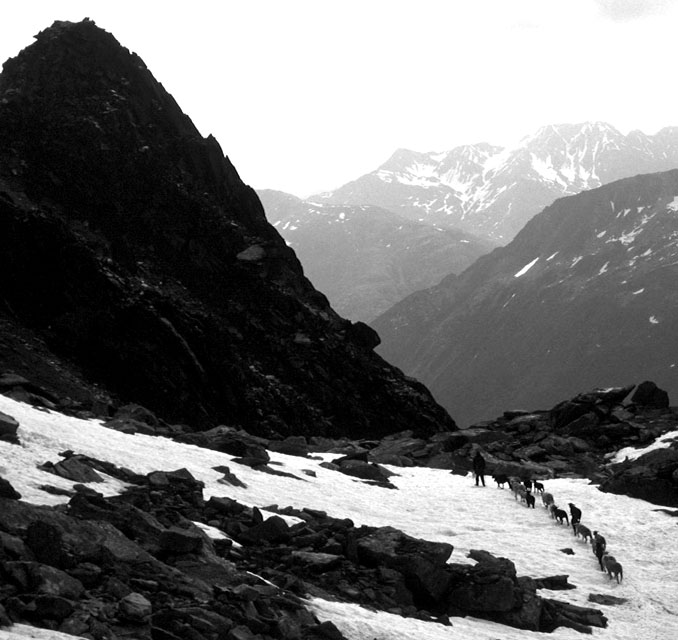
This week, an image
called
Shepherd Rock, Gathering the sheep
—the Alps. Also: two new
translations from the German.
|
The guest poems for this week are two new English
translations from the work of the German
language poet,
Rainer
Maria Rilke (from the
Rilke website, a concise hyperlinked biography).
Mountains of the Heart . . .
Rilke wrote the Sonnets
to Orpheus
*
at his modest chateau in Muzot, Switzerland, during a
period
of intense activity in February of 1922. It was to be his last published
work. The sequence of 55
poems, all sharing the same basic form and divided into two parts, is
characterized by a marvelously
light and quick energy. Indeed, they seem filled with the exuberance of the
mountains in which they
were composed, where everything seems larger than life, colors brighter and
more radiant, and
streams faster and more clear.
This then is a poetry of praise, of the air I breathe, the meadow through
which I walk, the beauty
of a single windflower opening to receive the morning sun, and yes, of praise
itself:
XXVI [ZWEITER TEIL]
Immer wieder von uns aufgerissen,
ist der Gott die Stelle, welche heilt.
Wir sind Scharfe, denn wir wollen wissen,
aber er ist heiter und verteilt.
Selbst die reine, die geweihte Spende
nimmt er anders nicht in seine Welt,
als indem er sich dem freien Ende
unbewegt entgegenstellt.
Nur der Tote trinkt
aus der hier von uns gehörten Quelle,
wenn der Gott ihm schweigend winkt, /
dem Toten.
Uns wird nur das Lärmen angeboten.
Und das Lamm erbittet seine Schelle
aus dem stilleren Instinkt.
|
XXVI [SECOND PART]
Torn away from us again and again
is the god of the place which heals.
We are sharp-edged, for we must know,
but he is divided and serene.
Even the pure, the consecrated gift
he declines to take into his world
in that he, unmoved, stands contrary
to the unfettered end.
Only the dead drink
from the spring heard by us here,
when the god silently waves to them, /
the dead.
For us, noise is all that is offered.
And the lamb begs for its bell
out a more quiet instinct.
|
[Ausgesetzt auf den Bergen des
Herzens]
Ausgesetzt auf den Bergen des
Herzens. Siehe, wie klein dort,
siehe: die letzte Ortschaft der Worte, und höher,
aber wie klein auch, noch ein letztes
Gehöft von Gefühl. Erkennst du's?
Ausgesetzt auf den Bergen des Herzens. Steingrund
unter den Händen. Hier blüht wohl
einiges auf; aus Stummem Absturz
blüht ein unwissendes Kraut singend hervor.
Aber der Wissende? Ach, der du wissen begann
und schweigt nun, ausgesetzt auf den Bergen des Herzens.
Da geht wohl, heilen Bewußtseins,
manches umher, manches gesicherte Bergtier,
wechselt und weilt. Und der große geborgene Vogel
kreist um der Gipfel reine Verweigerung.—Aber
ungeborgen, hier auf den Bergen des Herzens. . . .
(Irschenhausen, September 20,
1914)
[Exposed on the mountains of the heart]
Exposed on the mountains of the heart. See, how small
there,
see: the last hamlet of words, and higher,
and yet so small, a last
homestead of feeling. Do you recognize it?
Exposed on the mountains of the heart. Rocky earth
under the hands. But something will
flower here; out of the mute abyss
flowers an unknowing herb in song.
But the knowing? Ah, that you who began to understand
and are silent now, exposed on the mountains of the heart.
Yet many an awareness still whole wanders there,
many a self-confident mountain animal
passes through and remains. And that great protected bird
circles about the peaks of pure denial. But
unprotected, here on the mountains of the heart.
Rainer Maria Rilke (all tr. Cliff Crego)
| listen to Mountains of the Heart
in German original;
listen to English trnaslation
# |
| view / print Picture/Poem Poster:
Exposed on the Mountains of the Heart (86 K) | or
download as PDF |
| Selected Sonnets
to Orpheus twenty-two poems in the order they have been featured
(text only) | PDF of Six
Sonnets |
*
Orpheus is the musician of musicians
of classical Greek mythology. He is the one
whose magical art of the lyre has the power to charm the whole of
Nature—the trees,
rivers, stones and even the wild animals, into the silence of listening.
Son of Calliope,
the muse of epic poetry, and a Thracian river-god (in some versions of the
story Apollo),
Orpheus married the nymph Eurydice who was fated to die of a serpent bite
on her heel.
In his profound grief, Orpheus follows his beloved into the underworld, and
with the
sound of his lyre enchants the resident deities into consenting to her release.
The one
condition which Orpheus has to meet during the ascent back to the upperworld
is that
he is not to look back at Eurydice. In a brief moment of weakness, he does,
however,
look back, whereby Eurydice vanishes forever without a trace.
Rejecting all women in his sadness afterwards, Orpheus is later ripped to
pieces by the
Maenads. This then is the source of the famous image of Orpheus' lyre and
singing head,
floating off through empty space to the island of Lesbos.
| see also
the Rilke
Posters |
| listen to other recordings in English and German of twelve poems from
The Book of Images at
The Rilke
Download Page
(#
Includes
instructions) |
See other recent additions of new English translations of
Rilke's poetry,
together with
featured photographs at:
(37) August: Moving
Up into Mountain Time
(36) August: Lily, unfloding . .
.
(35) July: The Rhythms of Work in
Poetry
(34) July: Moments Out of Time
(33) June: The View to Infinity and
Back
(32) June: Every Poem a Prayer
(31) May: The Poetry of Coming and
Going
(30) May: Alder Spring
(29) April: Willow Spring
See also a selection of recent Picture/Poem "Rilke
in translation" features at the Rilke
Archive.
|
See also another website
by Cliff Crego:
The Poetry of
Rainer Maria Rilke
|
a presentation of 80 of the
best poems of Rilke in
both German and
new English translations:
biography, links, posters
|
| back to Picture/Poems: Central
Display |
|
Map
|
TOC:
I-IV |
TOC:
V-VIII |
Image Index
|
Index
| Text Only
| Download
Page |
Newsletter
|
About
P/P |
About Cliff
Crego |
Photograph/Texts of Translations © 1999 - 2001 Cliff Crego
(created:
VIII.26.2001)
