cih—for flute solo
from a set of five virtuoso StarCycle pieces
cih—for flute
solo
from a set of five virtuoso StarCycle
pieces
(a fragment from the end of the piece (page
3))
| pages movement I 1 |
2 | II
1 | 2 |
III 1 | 2
| 3 | IV
1 | 2
| V 1 |
Listen to QuickTime performance models of
| I :
preludium |
|
II :
nightmusic I |
| III :
sonata |
| IV : nightmusic
II |
| V :
aria and coda
|
Download free iPad performance score PDF (ten 11" x 17" pages: 264 K)
Download PDF of this INTRO + SCORE + study POSTERS (36 pages: 1.2 Mb)
Download mp3 of performance model Cih: complete cycle mp3 (c. 13' 08") [3 Mb]
For many years, I've had the privilege of living in a very small, remote alpine village
in the heart of the European Alps. The nearest road is about eight kilometers away,
there are no cars and but few artificial lights of any kind. There, on moonless nights
in the middle of January, the crunch of one's boots kicking into a hard layer of frozen snow
is almost too loud to bear. That's how quiet it is. The depth of the silence at night seems
to find its perfect complement in the vastness of the heavens above. Nothing stands
between one and the stars; there's just you and the clear mountain air, and, of course,
your own thoughts. Personally, I am always profoundly moved when this sense of a more
basic, primal world appears, a world that would have been intimately known by
other inhabitants of this place a thousand, two thousand, or even perhaps as much as
100 thousand years ago. Remarkably, this world is still there, alive, at the present moment,
but only covered up—hidden one could almost say—by the many layers of noise of
different kinds we have unintentionally and unknowingly allowed to accumulate upon it.
On nights like this, I always liked to follow the movements of one or two constellations.
Orion was of course always there, looming large over a high ridge to the south like an
immense cosmic warrior. But frequently direct overhead, within the band of the Milky
Way, a compact, brilliant *W* shape would also catch my eye. And there was sometimes
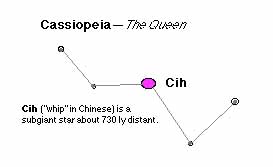
one star among them that was breath-taking. That star was, I was later to learn, called
by astronomers cih. The constellation is, of course, The Queen, or Cassiopeia, wife
of Cepheus and mother of Princess Andromeda. It is the name of this star, which I like to
pronounce simply like the English letter 'c', barely visible in the cities of Europe
or North America, which I've borrowed for my cycle of five pieces for solo flute.
The particular movement featured here—the third—is a kind of sonata in the sense of
a strong back and forth of two contrasting qualities of musical movement; it also forms
the central piece in the set of five. (All five pieces of the cycle may be played independently.)
As a piece for unaccompanied solo flute, cih in turn forms part of a much larger cycle of
new compositions for acoustic instruments I call together the Star Cycle. (See also the
introductions to spica—for percussion solo and m4—for cello solo.)
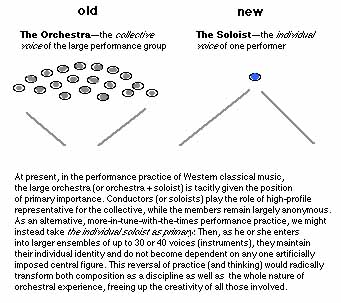
Why a cycle of solo pieces? Well, there are many reasons for this. First is that I
would like to place the individual virtuoso performer center stage as a kind of starting
place for the exploration of both a new language of music as well as a new way of
doing or performing music.(In my view, these two are inseparable.) This is in
distinct contrast to the very much still lingering romantic tradition of taking the large
orchestral ensemble as in some sense being primary. When there are many fundamental
problems which need to be addressed—many of which relate to music's relationship
to the world around it—I feel that it might be a good idea to 'go light', as it were. After
many years of experience as artistic leader and conductor of larger ensembles for new
music, I've come to prefer listening to what an individual composer and performer
can do together. I like to see—given the challenging limitations—if they can conjure
up whole new musical worlds 'out of thin air', so to speak, and share these in a
meaningful way with their audiences. *
In a way, this is directly related to my approach to poetry. (See a collection of my
photographs, poems, miniatures and essays at another website, picture-poems.com)
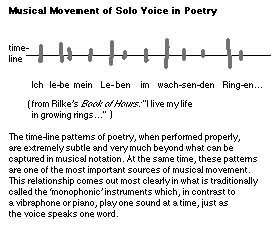
After all, we normally hear a poem by means of a single voice or source. When one
listens musically to the poem, its rhythm, the kind of shape or trail of beats and accents
it leaves behind in time, this is not that different than listening to, in this case, a piece
for solo flute; and vice versa,
when one listens poetically to the the music, the imagery evoked, the large-scale form
unfolded, this can be remarkably similar to hearing a poem. When I encounter a new
poem or kind of poetry, the first thing I want to hear is the poet perform it his or herself.
Just a single poem. A minute is enough. If there's something there, it will reveal
itself I feel in the voice. Likewise in music, I prefer to hear a single solo composition.
For it is here that the strengths and weakness of a musical language instantly, without
hiding behind the massive effects of the orchestra, reveal themselves. What is the
continuity like, the storyline of the music? Does the music come fully to life in
the hands of the performer, in the acoustics of the particular space, or does it remain
an abstract model merely transposed to a traditional instrument? These are important
questions which can then be clearly and unequivocally answered.*
Also, in connection with this difference between the large collective and the individual
voice, I might mention here the problem of standards. If orchestral and ensemble
performance practice is to be re-invented, then perhaps the place to start is with the individual
composer and virtuoso performer. This is because, as everyone knows, large orchestras
remain at present not only profoundly stuck in past repertoire, but also in an entire—in my
view then—outmoded approach to, or way of thinking about, Music and Art generally.So,
in all fairness, one can hardly expect anything new to happen there. At the same time, the
specialized ensembles which have in many of the larger cities of the Western world sprung
up out of necessity since the Second World War are, with all due respect, just that:
specialized. Personally, I feel that it's a great mistake to isolate new music from
both the great music of the past (of all traditions and cultures) as well as from other
art forms, especially poetry and dance.Yet that is precisely what has occurred. And
as many of the wonderful musicians of these contemporary music groups will tell you
in their more candid moments that the quality of many of the new pieces performed
nowadays remains dramatically less than both the quality and the level of technical expertise
of the performers themselves. There are many reasons for this, I believe, but just let me say
here that, in a small way then, I see the Star Cycle Project as a way of addressing a few
of these, all at once, and one at a time, as it were.
To sum up: If the large modern orchestra has come to represent what I like to call cracked
tea cup culture—the image is one of the precious china of wealthy patrons disintegrating
under the pressure of the opening bars of Varèse's Arcana, then the culture of the typical
contemporary performance group might be called that of the shattered wine glass. Here, the
image is of a much more heroic/tragic situation of small groups of highly dedicated and talented
individuals 'breaking themselves apart ', like the ringing glass in Rilke's Sonnet to Orpheus, in
their efforts to create a musical culture—largely unsuccessfully, in my view—that's truly alive.
This is briefly the general background situation as I see it, and why I've come to argue for what
I call a new creative tradition as well as a new approach to music for solo instrumental voices
that is of necessity no longer separate from especially the guiding spirit of poetry.
The Shape of ChangeBriefly, for the performer, here are a few comments concerning the unique rhythmic
continuity and notation of the third sonata movement of cih:
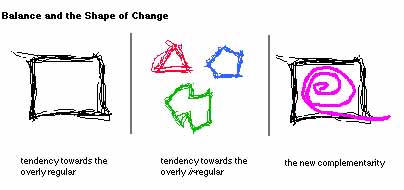
If it is true that music cuts a distinct pattern which we perceive, experience, remember
as the shape of change, then the music with which we have surrounded ourselves—
both commercial as well as much of the well-known classics—is definitely square.
I mean by this simply that the music both tends towards groups of four and
is almost always constant. (In musical terms, 'square' means 4/4 of some kind, whereas
'constant' means a non-changing regular tempo.) To its tremendous credit, the music
of the first half of the past century powerfully broke out of this rigid mold. We now
have the shifting, variable meters introduced and perfected by Stravinsky, Bartók
and Varèse. We alse have the simultaneous meters of Ives, and later, the variable tempi
introduced by Boulez and Elliott Carter. Of course, these experiements themselves
led to an imbalance of a different kind: instead of overly square, from the 1950's
onwards, there was a tendency to become overly irregular, which has given us a kind
of anti-commerical music, one without meter—that is, the feeling of moving the body
to a pulse—altogether. (One could say that what has come to be known as 'minimal music'
is just that, a rather over-simplified reaction to this.) I would suggest that what we need
is rather complementarity, an approach in which the balance of both regular and irregular
patterns is taken as primary, and not any one side of what is really a feature of natural
movement generally. (See poster: Understanding the Shape of Change)
Glissandi in Time
In this particular movement of cih, I've borrowed especially from the work of
Elliott Carter and his Double Concerto for Harpsichord and Piano (photo). I conducted
this piece a number of years ago, working together with the composer, and was very
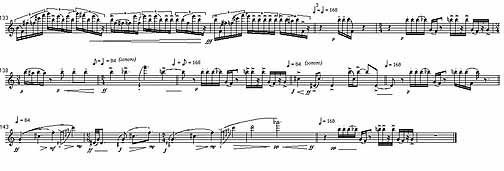
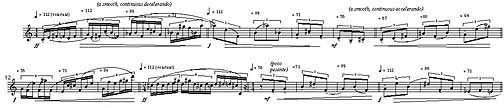
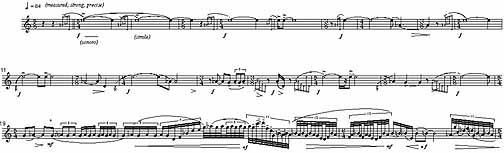
taken with the originality of its central movement. Here's a fragment from the beginning
of the flute piece, which features similar patterns of accelerando and decelerando, but
used here in a very different way:
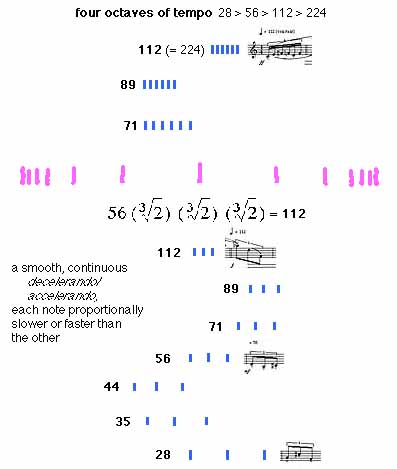
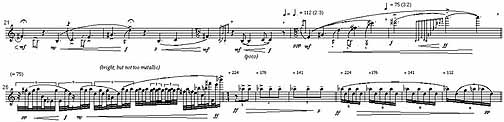
Now, the key musical or rhythmic feature here—the shape of the music's change—
is a smooth, continuous 'getting faster' and 'getting slower'. The music does this
in a necessarily very precise way, moving in steps until the tempo or speed of the
basic meter is doubled, then doubled again, and again. Or vice versa: halved and
halved again, and so forth. This is directly analogous to singing or playing a sliding
tone—a so-called glissando—from one pitch to another one an octave higher, and
so on. That's why I call these doublings of tempo octaves. Here's a sketch of the
cycle of relationships. (Mathematicians, among whom I unfortunately do not include
myself, will notice, to use their language here for a moment, a fractal-like iterative
function at the root of this pattern of movement, with self-similar relationships at
differences of scale. The key remains, however, that it sounds beautiful, much as if
the graceful spirals of ferns had been translated into sound.(see photo/miniature:
metaphor) This phrase—self-similar relationships at a differences of scale—is an
important one to remember, I think. This is because it points to a simple yet powerful
way of looking at or thinking about both structure and movement in the future.):
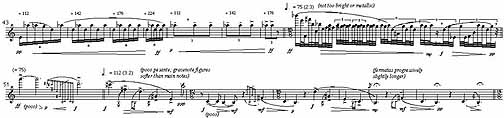
Rhythmic "Spin Outs"
Another rhythmic feature of the music is the way it "spins out" of the continuously
changing patterns sketched above into fast passages in a contrasting, constant meter.
It is especially this higher-level distinction that gives the third movement its sonatina
quality:
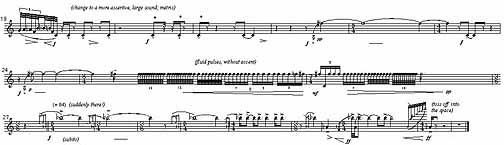
The "Open Center"
And lastly, there's a nested "open center" or brief slow movement in the middle of
the piece. It is full of silence, and the unique quality of the flute's lower register:
The Natural Balance of Simplicity and Complexity
In closing, I should also briefly say something about musical complexity and
difficulty as seen especially from the performers point of view. This is a topic
I have over the years out of necessity given considerable attention to, in early
years as a conductor—I was known in the past for taking on with the greatest
possible integrity even the most challenging scores, especially in my work with
the ASKO Ensemble**—but more recently also in cultural philosophy and poetry.
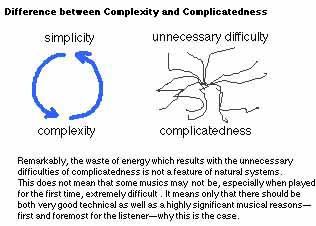
In my experience, the first step on the road to clarity
is to sharply differentiate between true complexity—
which in this way of thinking is always good,
and that which is merely complicated—
which is always bad.
So I'm introducing here a crucial difference in the use of the two common words.
Complexity is the richness of the many-voiced, intricate weave which finds
its perfect complement in the plainsong of simplicity's single thread.
Complicatedness, on the other hand, has nothing to do with these,
and is merely what one might call unnecessary difficulty.
Those are two important words for the performing artist to remember.
In my view, unnecessary difficulty should not be tolerated. It seems to me that,
following nature's example here, we ought best strive for the most elegant solution
to the problems at hand. But how? Well, generally, I would say by simply taking
away, by doing away with all the things that get in simplicity's way. Interestingly, this
is directly analogous to how one learns to play without tension: one does not—indeed,
one could say as they do in the Alexander Technique—one cannot try to perform
without tension. Instead, one simply gives attention to the facts of unnecessary tension
as they maifest and thereby becomes increasingly aware of their source.)
In this context, one of the main obstacles on this road to clarity is what I would
call the cult of complicatedness. One could argue that this is a powerful force in Western
culture generally. In poetry, this happens when, for example, the unity of meaning and
movement are not attended to properly as one whole; in music, it occurs, for example,
when composers and performers alike confuse physical density and a kind of athletic
hyperactivity—as well as the superficially sophisticated notation which has co-evolved
with these—with real musical inerest, intensity or expression.
So one of my intentions with regard to this set of pieces for flute, as well as the Star-
Cycle generally, is to create a virtuosic music for the best of a new generation of New
Music performers which embraces fully this natural complementarity of the simple
with the truly complex, but which also works diligently to eliminate all that is merely
in the way. This is of course by no means a small task. That is why I think it best if we
find our points of orientation—right from the very beginning—in distant stars, regardless
of how faint and or how unfamiliar they might at first appear.
| mouseover for controls / lower left for full-screen mode |
* The question of which musical body we consider central or primary—that
of the large orchestra or individual soloist—is related to the similar question
in literature of which form is seen as most important, the full-length novel
or the short poem. I would without hesitation, in both cases, say the latter.
This is especially true, perhaps, in times like the present era of metaphysical
and spiritual crisis, for it is with both the performing solo musician as well as
the solitary poem, more than any other art forms, I believe, that the whole
question of meaning, logic and relevance is necessary refined for the listener
or reader to its most essential possible expression. With this comes, when we
are persevering and lucky, the miracle of clarity.
** I started working with the Amsterdam Studenten Kamer Orkest
in January 1974. At the time, as the name suggests, this was an amateur
ensemble well-known for its relatively high level of performance practice
and its exclusive focus on contemporary music. I became its conductor
and music director the same year. In the summer of 1974 I founded
together with Fons van Esch a smaller, professional group we called
simply the ASKO Ensemble. (I remember the date vividly.The evening
before Richard Nixon had just resigned on late-night Dutch TV..
Both Fons and I had the feeling we were entering a new era, so
we decided to mark the moment with a plan for a new group.)
That summer we started rehearsal with two pieces which were to become
important to the character of the group, Edgar Varèse's Octandre, and
Anton Webern's Concerto Op. 24. Later signature pieces were
my own Schlieren and Pharos, Charles Ives' Over the Pavements;
and Iannis Xenakis' Anaktoria.

Copyright © 1999-2013 Cliff Crego All Rights Reserved